One Notebook or Several Loose Cards?
Choose a notebook or question cards for keeping curiosity alive: compare continuity, rearrangement, portability and review before settling on a format.
Should you keep questions in one notebook or on separate cards? For question keeping, the choice comes down to whether you value a visible trail of thought or the freedom to move ideas around. A notebook gives each question neighbours and a place in time; cards make each question an independent piece you can sort, group or carry.
Neither format is automatically better. Choose for the way you expect to handle questions after writing them down, not for how tidy the stationery looks. These distinctions can help you settle on one format—or combine them without creating two competing archives.
1. Choose a notebook when the trail matters
A bound notebook preserves the order in which questions occur. A note about why something caught your attention can sit beside the question, and a later thought can follow on the next line. That makes a notebook useful when you want to see how one curiosity shifts into another.
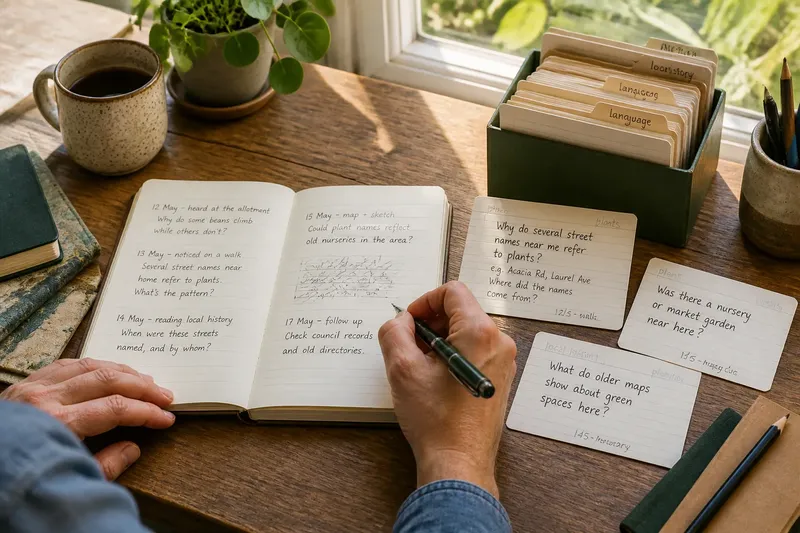
Write the date and a short cue alongside each entry, such as “heard at the allotment” or “noticed on a walk”. The cue gives future-you a reminder of the original spark without requiring a long account. Leave a little space after an entry if you tend to return to a question and add observations.
The trade-off is that a notebook is difficult to rearrange. If questions about local birds appear on scattered pages, they stay scattered unless you add an index or copy them elsewhere. Treat the notebook as a chronological record, not as a perfectly organised catalogue.
2. Choose cards when rearrangement matters
A question card can hold one question, a clue about its source and a short note on what you already know. Cards let you put related questions together on a desk, separate a new branch of interest, or remove one prompt from a larger group. This is useful when your curiosity changes shape as you collect more questions.
Use cards that can be shuffled without difficulty, and keep the writing large enough to read when several are spread out. A small heading such as “plants”, “language” or “local history” can help, but avoid squeezing a full explanation onto the card. Put extended reflections in a separate notebook or on the reverse only if you are comfortable handling a thicker stack.
Cards have their own weakness: they can drift apart. A single missing card may take its source note with it, and a loose pile can become hard to scan. Keep them in a labelled box, envelope or ring, and choose a regular place where cards return after use.
3. Compare the formats by how you revisit questions
Imagine you notice that several street names near your home refer to plants. In a notebook, you could record each name in sequence, noting where you saw it and what it made you wonder. The pages would preserve the route of your interest as it develops.
With cards, you could write one street name or question per card, then place the related ones together as the collection grows. You might notice a cluster that deserves its own line of enquiry, while keeping unrelated questions separate. The expected observable result is a group you can rearrange at a glance, rather than a sequence fixed to pages.
Ask yourself what you want to see when you return: the path that led to a question, or the questions that belong together now? A notebook is like a paper trail, with each entry following the last. Cards behave more like recipe cards: you can bring a few forward without moving the whole collection.
4. Match the format to where you capture ideas
If you usually pause at a desk, either format may work. If questions come to you while travelling, walking or waiting, consider what you can carry and use without fuss. A pocket notebook is ready for a quick line, while a loose card may be awkward to keep flat or easy to misplace.
You do not need to carry your whole collection. Keep a small capture notebook or a few blank cards with you, then transfer each question to its home when convenient. If you use a phone for quick capture, decide whether it is a temporary holding place or your permanent record; otherwise, questions can end up split between paper and screen.
Think about how you write, too. Someone who adds sketches, arrows or a paragraph of context may prefer pages. Someone who likes moving prompts into temporary groups may find individual cards easier to handle.
5. Use a hybrid only when each part has a clear job
A notebook and cards can support one another if you assign them different roles. For instance, the notebook can preserve first thoughts and context, while cards hold questions you want to sort together. The arrangement becomes confusing if you copy every entry into both places without a reason.
Say you keep a notebook for passing observations and decide to make cards only for questions that keep returning to mind. When a question earns a card, copy its wording and add a brief pointer to the notebook page where it began. The expected observable result is a compact, rearrangeable set of active questions alongside a dated record of how they arose.
If you choose this arrangement, make the hand-off simple. A card might carry a page reference; a notebook entry might say that a card now exists. Do not make the system depend on repeated transcription, or it may feel like filing work rather than a way to keep curiosity in view.
6. Decide by trying a small working set
Before buying a large notebook or preparing a box of cards, try the format with a handful of current questions. Keep the trial simple: capture each question in the same way, then notice what you wish you could do with it. The useful signal is not whether the pages or cards look neat; it is whether you can find, understand and handle the questions when you return.
- Observe whether you want to trace when and where each question arose; if you do, choose a dated notebook, otherwise use cards when rearranging matters more.
- Observe whether related questions are hard to compare on separate pages; if they are, move those questions to cards, otherwise keep their notebook entries together with a brief index.
- Observe whether you capture questions while away from a desk; if a pocket notebook is easiest to use, carry one, otherwise keep blank cards near your usual writing place.
- Observe whether loose cards have a reliable home after each session; if they do, use a labelled box or envelope, otherwise prefer a bound notebook.
- Observe whether you need both a dated record and movable groups; if each has a distinct job, use a hybrid with a page reference, otherwise keep one main format.
- Observe whether you hesitate because the system requires copying entries; if you do, stop duplicating them and choose one home for new questions, otherwise retain only the hand-off that helps you find context.
Imagine you have three invented questions: why a nearby lane has a tree name, which birds visit the allotment, and what an unfamiliar word on a café menu means. You write each on a card, adding its source cue, then try to group them; the unrelated word question sits apart, while the lane and bird questions both concern local places but do not yet form one enquiry. Since this made rearranging straightforward but left you wanting a record of where the questions began, you keep the cards for active grouping and start a notebook for new observations, adding a page reference only when a question moves into the card set.
Questions that help you choose a format?
Can I move notebook entries later?
You can copy selected entries onto cards or add a simple index, but the original pages will remain in their recorded order. If rearranging is central to how you think, cards may be the more natural home for those questions.
How do I keep loose cards from becoming a jumble?
Give them one regular container and use brief headings or dividers only when they help you find a group. If you find that sorting takes more attention than the questions themselves, keep fewer cards active or use a notebook.
Should each card contain only one question?
Usually, one main question per card makes rearranging clearer. Add a related sub-question when it cannot be understood apart from the main one, and keep background notes short enough to scan.
What if I already have questions in several places?
Pick one home for new questions first, rather than copying every old note at once. Move older entries only when you need them, preserving useful context and leaving the rest where they are.
Make the format serve the question
For question keeping, a notebook preserves continuity; loose cards make rearrangement easy. Choose the format that supports the action you most want to take when an old question catches your eye. If your needs change, move a small, useful set rather than rebuilding the whole collection.
Write the next question in the format you can reach today. Add enough context to recognise why it mattered, then leave yourself room to change how you sort it later.