A Question Walk for a Familiar Route
A question walk turns an ordinary journey into a shareable curiosity, with a simple way to capture a route, a detail and a question for others.
What can you bring back from a familiar walk that another person can help you notice? A question walk gives you a way to share the route itself: choose a stretch of pavement or park path, notice how moving through it changes what you see, and leave one clear question for someone else to consider.
The walk is not a hunt for a hidden answer. Its useful result is a small invitation that another person can respond to without needing to retrace your exact steps. Like passing someone a marked-up map, you are showing where your attention went and asking what they see from there.
Choose a route that can be described clearly
Pick a public route you already use, such as the path from a bus stop to a park gate or a circuit around a familiar square. A route with recognisable landmarks makes it easier to share the question later. Decide on a broad theme—sounds, signs, surfaces or changes in how a space is used—rather than searching for a particular object.
Keep walking safely and avoid stopping where you block others. You do not need to inspect private property or approach a feature closely. If the route is busy, uneven or distracting, leave note-taking until you have reached a safe place.
Let movement reveal a useful contrast
Notice what changes as you pass a place: a sound that fades behind a wall, a patch of shade that shifts across a path, or a line of paving that continues around a corner. A question tied to movement gives another person something to compare, rather than only a detail to identify.
Keep description separate from explanation. “The paving changes from smooth slabs to rough blocks beside the gate” is something another walker can look for; “the rough blocks prevent slipping” is a possible explanation that needs checking. Start with the part someone else could recognise.
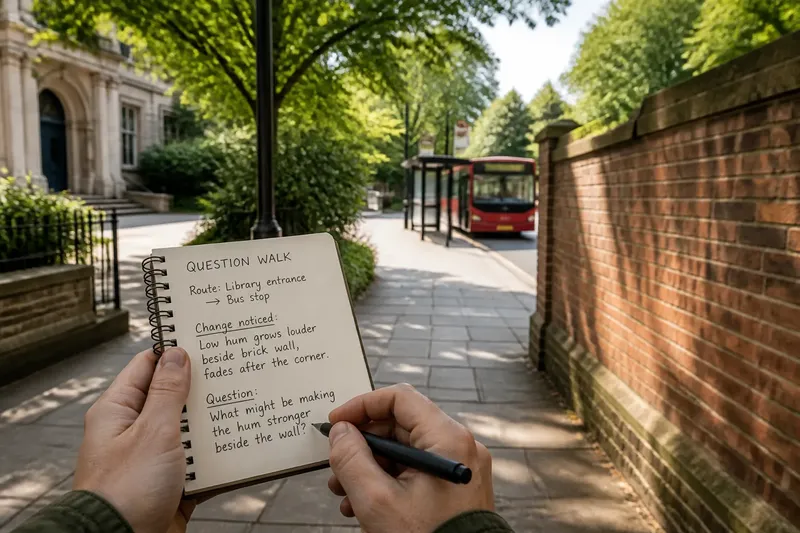
Say you walk from a library entrance to a nearby bus stop and hear a low hum that grows louder beside a brick boundary, then fades after the corner. You record the route, the change in sound and the question, “What might be making the hum stronger beside the wall?” A friend who takes the same route can listen at those points and report whether they hear the same change, giving you a useful comparison without treating either impression as a settled answer.
Make a record another person can follow
Capture the question when it is safe: use a pocket notebook, a short voice memo or a note on your phone while stationary. Include the route’s start and end landmarks, the detail’s position along it, what you noticed, and the question. A photograph can add context, but do not include identifiable people or private details without a good reason.
Before sharing, check each part and decide what to do with the result:
- Check that the start and end landmarks are public and recognisable; if they are, name them, and if not, replace them with a broader public landmark.
- Check that the observation describes something visible or audible rather than an explanation; if it does, keep it, and if it assumes a cause, rewrite it as a direct description.
- Check that the question can be explored by noticing or comparing something; if it can, share it, and if it is too broad, narrow it to one feature or change.
- Check that your note gives the feature’s position along the route; if it does, leave it, and if not, add a landmark or direction that helps another person find the same point.
- Check that a photo or recording contains no unnecessary personal information; if it is clear, include it, and if it identifies someone or a private place, crop it, remove it or share the text alone.
- Check whether the feature could be unsafe, damaged or on private property; if it could, do not invite close inspection, and instead describe only what is visible from a public place or ask an appropriate organisation for advice.
Share the question without prescribing the answer
Send the note to a friend who knows the area, or post it in a relevant local group if that group welcomes this kind of observation. Say what kind of response would help: a comparison from another part of the route, a clearer description, or a suggestion for a source to consult. Do not ask people to trespass, disturb wildlife or investigate a potential hazard.
When someone replies, keep their observation distinct from your own. If they notice the same feature elsewhere, add that as a second location; if they offer an explanation, record it as a possibility until you have a suitable way to check it. That makes the shared question a starting point for conversation rather than a claim about the place.
What should you do with a question walk?
What if nobody else knows the route?
Describe the route with public landmarks and the order in which you pass them, rather than relying on local shorthand. If the location still is not clear, share a simple sketch or a safe, non-identifying photograph.
Should you share a photograph?
Use one only if it helps another person recognise the feature or its position. If it shows people, private addresses or details unrelated to the question, leave it out or edit it before sharing.
What if another person gives a confident answer?
Keep the answer as a lead, not a fact, unless it comes with a way to check it. Ask what observation or reliable source would distinguish that explanation from other possibilities.
Can the question stay unanswered?
Yes. You can keep the note, add another person’s observation later, or let the question rest if no useful next step is available. An unanswered question can still help you notice the route differently next time.
Keep the route and the response together
After sharing, save the original note alongside any replies, so you can tell what you noticed from what others added. The phrase “question walk” can be a useful label for this practice: a route, a change noticed while moving, and a question another person can meet with their own attention.
On a later walk, revisit the same stretch only if it is convenient and safe. Compare what you notice with the original note, then add the new observation without replacing the first; that gives the conversation a clear trail from one person’s walk to the next.»