From Cabinets of Curiosities to Personal Question Lists
Use the cabinet of curiosities as a model for a personal question list, so you can revisit intriguing subjects without keeping every object.
How can a cabinet of curiosities help you keep returning to a question? A cabinet was not just storage: it arranged unusual objects so visitors could compare them, discuss them and notice how a collector had chosen to make sense of the world. You can borrow that curatorial habit for a personal question list, without needing a collection of your own.
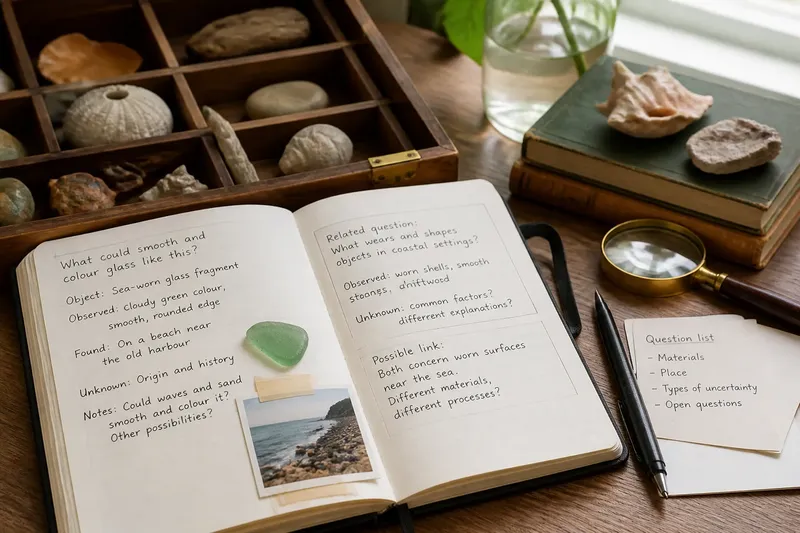
Imagine a hypothetical situation: Mara sorts a box of family keepsakes and finds a sea-worn glass fragment. She notes its cloudy green colour and rounded edge, but has no information about where it came from. Rather than turn the fragment into a family story, she writes down what she can ask about it and keeps the uncertain history clearly marked.
Use the cabinet as a model for arranging questions
Cabinets of curiosities placed unlike things side by side. A shell, a carved piece of wood and a map could share a space, inviting visitors to compare their materials, origins or forms. The cabinet made its owner’s choices visible: what had been selected, how it had been grouped and which connections seemed worth considering.
That history offers a different way to think about a question list. Treat each entry as a small curatorial decision: preserve the detail that caught your attention, name the uncertainty, and decide whether it belongs beside another question. A list can then show not only what you want to know, but how your interests sit together or diverge.
Mara writes, “What could smooth and colour glass like this?” She places the question near another note about worn materials, but does not claim that the two have the same explanation. The arrangement gives her a possible connection to revisit while leaving room for the questions to lead in different directions.
Write a question that keeps its context
“Glass is interesting” records a reaction, but gives you little to resume later. “What could change the surface and colour of a glass fragment?” names a subject and a point of uncertainty. Specific wording works like a label on a drawer: it helps you find the thread again without pretending to settle it.
For each entry, keep three things together: the prompt, a brief description of what you noticed, and what you do not know. Mara records the fragment’s green colour and smooth edge, where she found it, and the fact that its source is unknown. She keeps observation separate from explanation, so a guess cannot quietly become part of the record.
- If you can describe a visible feature, write that description; if you cannot, revisit the object or note what information is missing.
- If you know where you encountered the object, record the place or setting; if you do not, mark the location as unknown rather than guessing.
- If you can phrase an open question, write one that names the uncertainty; if it assumes an answer, rewrite it to leave plausible explanations open.
- If a detail is your interpretation rather than something directly observed, label it as a possibility; if you cannot separate it from observation, leave it out for now.
- If another question shares a clear subject or material, place the entries near each other; if the connection is only a hunch, keep them separate and note the possible link.
- If the object is borrowed, fragile or inconvenient to keep, preserve a written description instead; if a photograph is appropriate and permitted, save it as a reference, not proof of origin.
Keep the enquiry when the object moves on
An object may be borrowed, fragile, bulky or difficult to identify. The question can remain useful after the object is returned or put away. This shifts the purpose of the practice from possessing things to keeping a record of what made you curious.
Mara returns the fragment to the keepsake box and keeps a written description. If she takes a photograph, she labels it as a personal reference and not evidence of the glass’s source. Her question list preserves enough context to continue without requiring the fragment to stay on display.
Say you have a small shell from a visit to a beach, and its ridges catch your attention. You write down where you found it, describe the ridges, and ask what might account for their shape; then you return the shell to its owner. The resulting entry keeps the location and the question together, while the shell’s identity remains unresolved until you have information that supports an answer.
How do you organise and revisit a question list?
Should questions be grouped by object or subject?
Group them by the connection that helps you resume them: a shared material, place or type of uncertainty may be more useful than the objects’ original arrangement. If the link is tentative, keep the entries separate and add a brief note about what might connect them.
What should you do when a question has several parts?
Split it when its parts need different kinds of information. Mara could keep separate questions about the fragment’s colour and its smoothed edge, then decide later whether those enquiries belong together.
How can you record something you cannot keep?
Write a short description, note where you encountered it if known, and preserve the question that it prompted. Use a photograph only when suitable and permitted, and do not treat an image as evidence of an object’s history.
What if you no longer want to pursue a question?
Leave it on the list, mark that your interest has paused, or remove it if you no longer need the record. The list is a place to arrange attention, not a promise to investigate every entry.
Return with a clearer boundary between clue and claim
Later, Mara finds a book about coastal materials and checks whether it discusses changes to glass surfaces. She adds what the book helps her understand about glass in general, while keeping the fragment’s specific origin marked as unknown. Her entry has gained context, but it still does not claim more than the available clues can support.
Returning to a question can mean refining it, connecting it to another entry or deciding that it remains open. For a personal question list, keep the cabinet-maker’s habit in mind: arrange what has caught your attention, make your choices visible to yourself, and leave uncertain connections labelled as uncertain. That gives you a useful place to pick up the thread when the next object or idea makes you pause.